
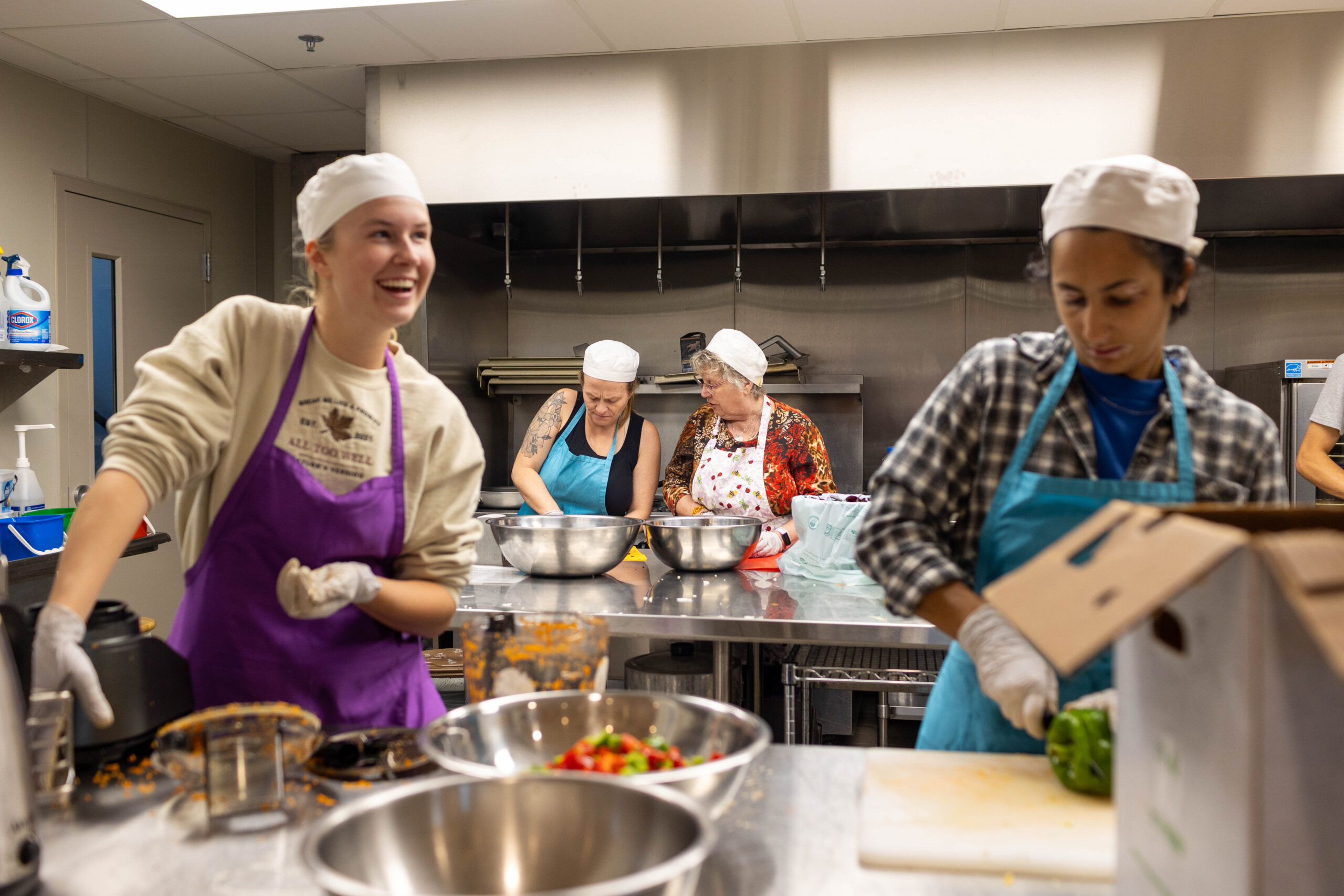
It was 8:30 am on a Monday, and a group of women were gathered over a dozen cans of diced tomatoes, two gigantic pots and a calculator, figuring out portions. As the women bantered, everyone’s eyes started watering from the whirling automatic onion dicer. As the UMD medical student tossed another onion into the machine, everyone good-humoredly razzed her. Wearing the coveted onion goggles, she unapologetically smiled and shrugged.
The morning had started just 15 minutes earlier with a quick meeting. The diverse group of about 20 volunteers and employees had come together to prepare the week’s meal kits for Nourish, a hyper-local meal delivery program for people living in and near the Duluth Hillside, one of several programs run by the Duluth Center for Women and Children.
Every Monday, subscribers to the Nourish program receive a box prepared that morning, filled with fresh ingredients and sauces, and a recipe, to make a meal in 30 minutes or less. Half the participants pay for their weekly box. The other half, who have an identified need, receive theirs for free.
Aparna Katre, organizer for the Duluth Center for Women and Children and Interdisciplinary Studies Program Director at University of Minnesota Duluth, welcomed everyone and kicked off the day’s project.
“Today’s recipe is for jambalaya. We need 164 servings, 69 for kids,” she said before pointing out the ingredients for the regular and vegetarian recipes. Then people dispersed to wash, measure, cut and cook ingredients.
The idea for Nourish, a sort of grassroots Hello Fresh, was born from an evidence-based approach out of UMD, where professors sought to make an impact on the Central Hillside through implementing social entrepreneurship. Dr. Molly Harney was working with a group of women around trauma and parenting who were primarily living in the Steve O’Neil Apartments. “During that process, she realized that women are isolated and disconnected,” Aparna explained. “They need meaning and purpose. So, she had an idea to create a social enterprise.”
The group, First Ladies of the Hillside, was formed with the tagline “Invisible No More” focused on giving purpose – and visibility – to women living on the Central Hillside who were feeling overlooked. The group later became The Duluth Center for Women and Children.
To create a social enterprise, first the group needed to identify a need that they could fill. That’s when they connected with Aparna. “I was teaching an entrepreneurship class here at UMD,” she explained. “I got students and the women together in a class for a semester and we did exploration. We didn’t want to just do more of what is being done but [instead] find a gap that existed in the Central Hillside that we could fill.”
The group identified food security, both access to whole fresh foods, as well as the skills and confidence to cook these foods, as a need they could meet and the idea for the meal kits was born. “It made sense for the community,” Aparna said. “The meal kits could help households, over time, to transition to more healthy eating behaviors.”
The meal kits provide free fresh meals, including partially prepared components as well as some ingredients that still need to be cooked. A recipe is included, both to provide instructions on how to cook the remaining ingredients, as well as how to pull the entire meal together. This approach helps to build familiarity with specific ingredients that may not be familiar to everyone while building confidence in the kitchen, through practice.
UMD students worked with Aparna to collect information and data from the program participants to understand which parts of the program were working – and which parts weren’t.
They sought to answer the questions: Are the people receiving the meal kits actually eating the meals? Are they throwing out some food? How happy are they? “As we introduce new tastes and new, healthier foods, we had to meet meal kit recipients where they were on in their food journey,” Aparna said. “As we began to introduce newer foods, we looked at whether they were actually accepting those foods or not.” The team was then able to implement their findings in real time, adjusting the program to continue to better fit the needs of the community they were working with.
The nonprofit’s partnership with UMD and work with students has added the capacity to gather valuable insights. But it has also created tangible, real-life learning opportunities for students.
In addition, the program has brought important employment opportunities to a population that has fallen out of the workforce.
Staying true to the program’s original intent of engaging women on the Central Hillside who are looking to improve their lives and their community, the program provides an opportunity for people experiencing mental health issues or other life circumstances to engage in a trauma-informed work environment.
By creating a flexible and compassionate employment model, they’ve helped to get women back on their feet. “We have had some employees move on to other things,” Aparna explained. “They are now in full-time positions in other places.”
“Here, you feel like a mission is being accomplished… when you leave, you leave feeling full.”
DCWC Staff Member
Back in the kitchen, another benefit of the Nourish program is palpable.
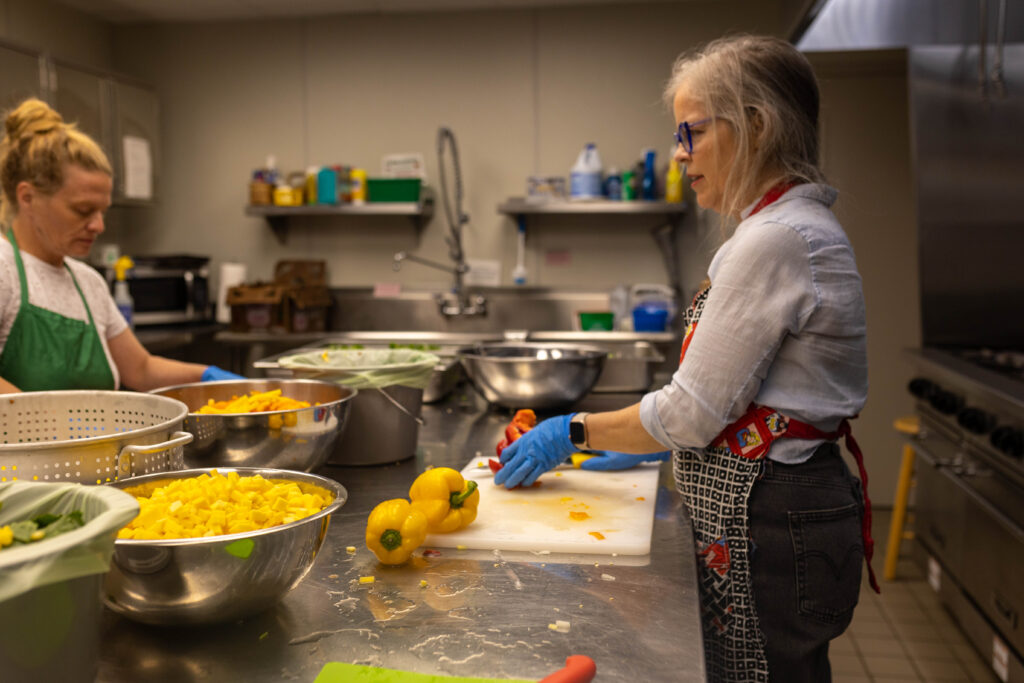
At one table, a young woman meets a middle-aged woman, who together scoop and bag servings of rice. In the kitchen, a half-dozen college students chop a mountain of peppers. Two veteran volunteers wash the reusable glass jars that will soon be filled with all the diced vegetables. Meanwhile, calculations complete, the staff have moved on from the cans of tomatoes to cook at the stoves and coordinate all the moving pieces that will culminate in a box filled with reusable jars of diced vegetables, a jar of jambalaya base, a bag of uncooked rice, and some trail mix (a snack for the kids). The food will all then be personally delivered to the doorsteps of homes in neighborhoods in and around the Hillside.
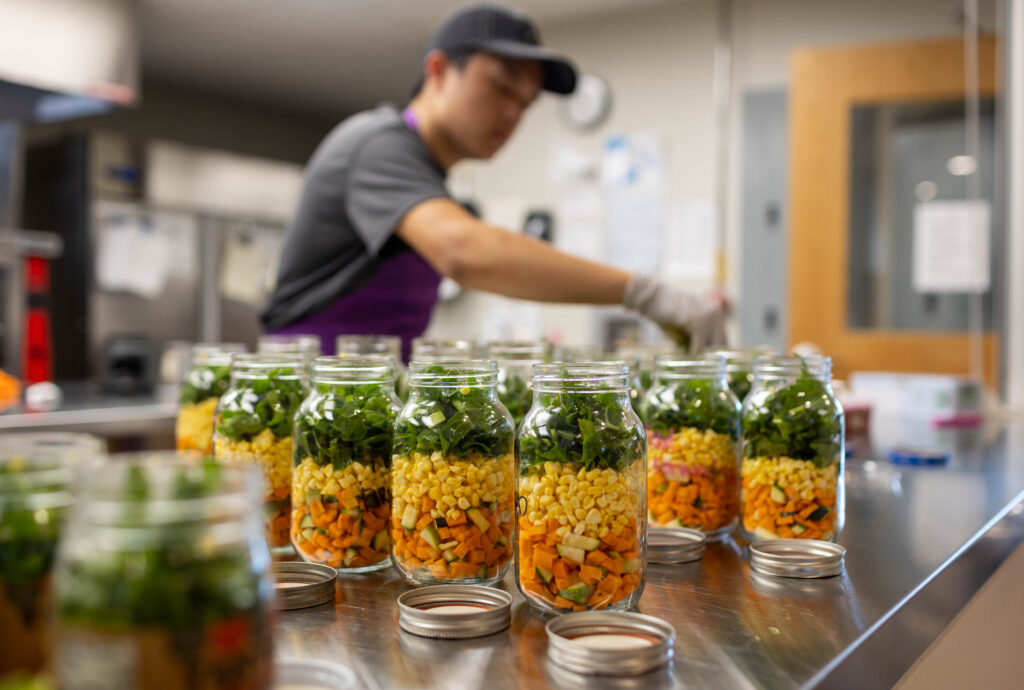
Photo by Molly Suzanne Creative
In every corner, there’s laughter and joy in doing good work for neighbors with neighbors. Person after person, when asked why they come back, share the sense of community they feel when working together.
“Here, you feel like a mission is being accomplished,” commented one of the staff. “When you leave, you leave feeling full.”
If you’re looking to get involved through donating, volunteering, or subscribing to a Nourish meal kit, visit dcwcnourish.com.