

Dave Rogotzke & Family
We’ve all heard the old saying, “Give a man a fish and you feed him for a day. Teach a man to fish and you feed him for a lifetime.” In the case of Dave Rogotzke, Owner/Producer of Simple Gifts Syrup and Salmon, teaching a man to fish turned not only into feeding himself, but providing enough fish for entire communities!
Dave, along with his brother, began fishing for salmon in Alaska while still in college. They spent two summers learning the trade and, after obtaining a loan from their dad, who mortgaged the family farm after assurances that his sons could indeed make a go of this, bought their first fishing permit and boat. Thirty-six years later, there are now four Rogotzke family boats fishing annually for Sockeye, King (aka Chinook) and Chum Salmon in the Bristol Bay area of Alaska. It is very much a family affair, with each of Dave’s three kids participating, particularly his oldest daughter Katie, who still goes out for two weeks each summer despite having moved from Minnesota to Montana.
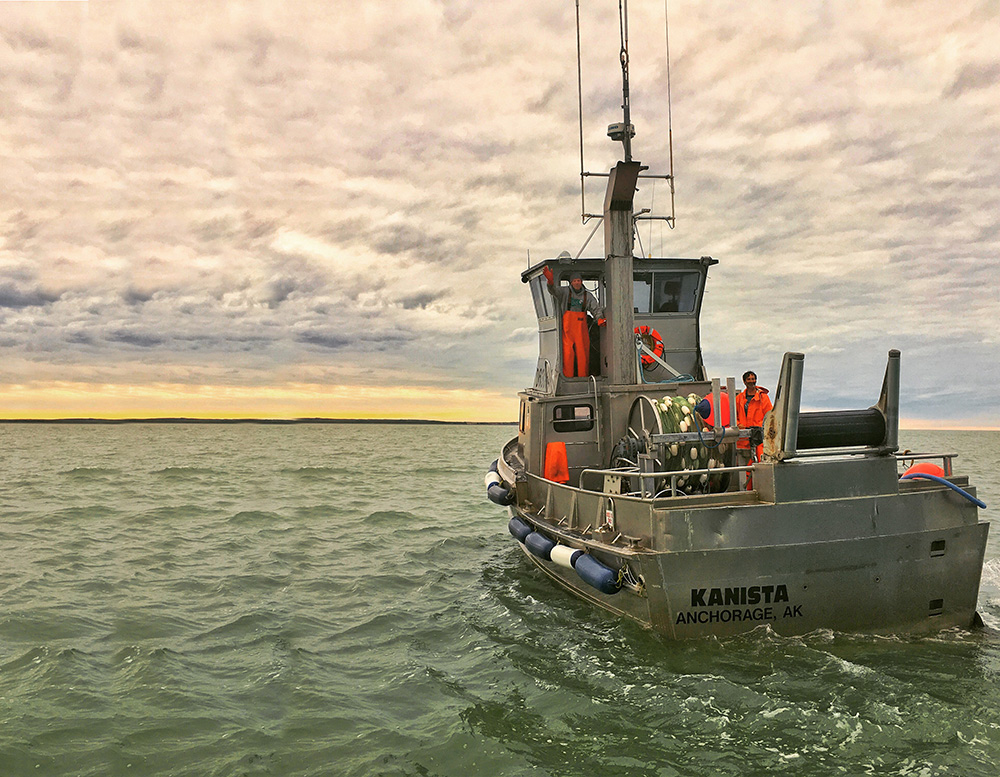
In order to ensure sustainability, fishing of wild salmon is heavily regulated and vigorously monitored. The fishing season in Bristol Bay is from mid-June to mid-July. Before fishing is allowed, state biologists make sure that enough fish have traveled upstream to spawn. When they ascertain the quota has been met, fishing is open for a certain period of time. The biologists will also determine which rivers the salmon are heading to, which helps the fisherman know how long they can fish for – in the beginning of the season it might only be for a few hours, but at its height fishing is twenty four hours a day.
Another method to protect the sustainability of the salmon is limiting the number of boats allowed. Annually only fourteen hundred fishing permits are available for boats in Bristol Bay. This also helps to ensure Alaska salmon stocks remain unthreatened or endangered and everything is strictly enforced. In fact, 2018 was the biggest year on record (since 1884) for salmon with over thirty three million salmon recorded in the Nushagak Bay alone!
Wild Alaska salmon are quite different from farm-raised salmon. Consider the many miles wild salmon swim throughout their lifetime – after hatching the fry (baby salmon) can be in the river for up to two years, then go out to sea to mature for up to another two years, and then back to the river where they hatched. This can add up to thousands of miles swum in their lifetime. When compared to farm-raised salmon, unable to leave their (sometimes) densely populated aquaculture net pen, this difference is very noticeable. Wild salmon are lower in calories, lower in overall saturated fat, higher in iron and other essential minerals and the taste is incomparable! Not to mention, wild Alaska salmon are delicious to eat because they come from the cleanest waters on the earth!
But one cannot fish all year long. Not wanting to rest on his laurels in the off-season, Dave started making maple syrup from sap produced by the roughly five thousand mature maple trees located on his property just outside of Duluth. Dave began making this precious commodity eighteen years ago, learning from his mentor Don Mount (who, prior to retirement, provided local maple syrup to the Co-op for years!). Starting with four hundred bags, Dave quickly realized he needed to find a better method. Cue the Canadian Minister of Maple Syrup (yes that is a real thing in Canada). Dave reached out to the Department of the Minister of Maple Syrup and was invited to come visit a number of their farms and production facilities. It was during this tour when he met Vernon Wheeler who taught Dave his method of running tubing from tree to tree to collect the sap and funnel it to the maple house where it is evaporated using reverse osmosis (drastically lessening the amount of time it takes to reduce the sap into syrup). Vernon’s son Mark then came from Canada to help Dave set up his tubing, along with a few well-placed pumps, and get everything up and running.
With an eye toward sustainability and keeping up to date on the newest methods, Dave returns to Quebec every few years to continue his education. One of the new methods he recently learned is using a smaller tap hole in the tree for the sap to run from – while that means a smaller yield from each tree, it is ultimately healthier for the tree because the hole will heal much faster, ensuring the tree’s viability for years to come.
Dave and his family’s commitment to protecting and nurturing both aspects of Simple Gifts Syrup and Salmon is obvious and infectious and they continue to provide sustainably sourced products of the highest quality. What began with the black dirt of his family’s farm in southwestern Minnesota, continues in the waters of Alaska and the maples of northern Minnesota. Simple Gifts indeed!
This article was originally published in the Winter 2019 Garbanzo Gazette.